

DRAGON – aDvanced x-RAy modelinG Of black hole wiNds
PRIN 2022: PROGETTI DI RICERCA DI RILEVANTE INTERESSE NAZIONALE (Grant: PRIN 2022K9N5B4; CUP: E53D23002080006 & CUP: C53D23001130006)
Research Unit 1: Francesco Tombesi (National PI), Marco Laurenti (University of Tor Vergata, Roma) & Research Unit 2: Eleonora Torresi (PI INAF), Massimo Cappi, Mauro Dadina (INAF-OAS, Bologna), Fabrizio Nicastro, Enrico Piconcelli (INAF-OAR, Roma)
DRAGON (aDvanced X-RAy modelinG of black hOle wiNds) is a research project dedicated to studying the high-velocity winds driven by supermassive black holes (SMBHs) in active galactic nuclei. These powerful outflows play a crucial role in shaping galaxy evolution, yet their physical nature remains poorly understood. DRAGON builds on the innovative WINE (Winds in the Ionized Nuclear Environment) model (Luminari et al. 2018, 2020, 2021) to perform homogeneous X-ray analyses of the most powerful quasars, deriving key physical parameters of their winds. The project also aims to develop an advanced version of WINE, ready to exploit the unprecedented sensitivity and resolution of XRISM and upcoming Athena space missions, paving the way for a new era of high-resolution X-ray spectroscopy of black hole winds.
During the active galactic nucleus (AGN) phase, powerful winds originating near the SMBH play a fundamental role in regulating the growth of both the black hole and the host galaxy’s stellar component. X-ray observations are essential to investigate these processes, as they probe the innermost and hottest regions of the outflows, which carry most of their kinetic energy. In X-ray spectra of AGN, these outflows are revealed through blue-shifted absorption and broadened emission lines, tracing ultra-fast outflows (UFOs) that can reach velocities up to 50% of the speed of light. Recent estimates of the kinetic power of UFOs suggest that they can trigger galaxy-scale outflows, thus establishing a direct link between nuclear and galactic feedback processes. Furthermore, lower-velocity absorbers (known as Warm Absorbers, WAs) observed in the soft X-ray band may represent large-scale counterparts or extensions of UFOs, produced through their interaction with the interstellar medium (Figure 1).
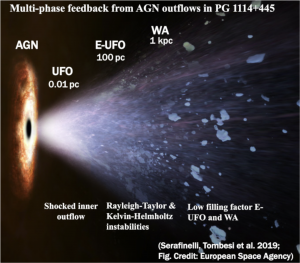 Figure 1. Diagram of the X-ray obser-
vations of the quasar PG 1114+445. A UFO is present in the inner part of the AGN surroundings, with decreasing density. At larger distances from the SMBH, the UFO interacts with the closest clumpy ambient gas at r~100 pc (E-UFO), entraining it via Rayleigh–Taylor and Kelvin–Helmholtz instabilities. This gas is pushed at velocities comparable with that of the UFO, retaining its ionization state and column density. The farther ambient gas remains unaffected by the UFO and therefore moves at a significantly lower line-of-sight velocity (warm absorber). Figure adapted from our team’s work Serafinelli, Tombesi et al. 2019 and related ESA press release.
The DRAGON project is organized into two main Work Packages (WPs), integrating observational and theoretical efforts to advance our understanding of SMBH winds and their role in galaxy evolution.
Together, the two WPs will consolidate and expand the team’s expertise in X-ray spectroscopy and theoretical modeling, establishing a long-term research hub for high-energy astrophysics in Italy.
WP1 focuses on the most comprehensive analysis to date of SMBH-driven winds using the largest existing X-ray database of AGN. Leveraging the WINE (Winds in the Ionized Nuclear Environment) model, recently developed by the research team, we will systematically characterize wind features in X-ray spectra to derive their key physical properties — including geometry, location, covering fraction, density, ionization, and velocity — in a homogeneous and self-consistent framework. This effort will provide realistic estimates of the mass outflow rate, energy budget, and mechanical power of disk winds in AGN, crucial for understanding the physics of accretion and feedback processes.
WP2 is devoted to the development and enhancement of the WINE code and its application to XRISM and next-generation X-ray missions.
This includes two major advancements: (i) comprehensive upgrade of WINE to achieve full independence from external photoionization codes and to improve atomic and radiative modeling; (ii) the implementation of a time-evolving photoionization module, enabling dynamic studies of wind variability and energetics (Figure 2).
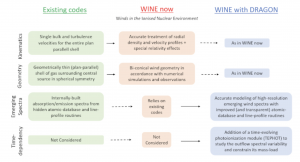
Figure 2: comparison between the state-of-the-art wind codes (left column) and WINE, both the current version and the one including the planned improvements with DRAGON (center and right columns, respectively).
Project Progress and Dissemination Activities
The DRAGON project has been highly productive across all its research lines. Members of the DRAGON collaboration have co-authored numerous papers (listed below) addressing the project’s main scientific objectives, which have already received significant attention and citations in the international literature. Additional studies and analyses are currently ongoing, with further results expected before the official end of the project (February 28, 2026).
A key aspect of the project has been the training and mentoring of postdoctoral researchers actively involved in DRAGON. Their participation has been fundamental to the development of new technical and scientific expertise in the field of X-ray astrophysics and black hole accretion and ejection physics.
The funding obtained through the PRIN MUR 2022 program has been instrumental in supporting the team’s participation in international conferences and scientific meetings, promoting the dissemination and discussion of DRAGON results within the broader astrophysical community. These activities have stimulated new collaborations and research initiatives, facilitated visits to partner institutions and international research groups, and enabled the collection of new observational data relevant to the project’s scientific goals.
DRAGON publications
- Kammoun, E., …, Nicastro, F., …, et al. 2025, XRISM/Resolve reveals the complex iron structure of NGC 7213: Evidence for radial stratification between inner disk and broad-line region, accepted for publication in ApJL, DOI: 10.48550/arXiv.2510.24971
- Serafinelli, R., Nicastro, F., …, Piconcelli, E., et al. 2025, Time-evolving diagnostic of the ionized absorbers in NGC 4051. I. High-resolution time-averaged spectroscopy, accepted for publication in ApJ, DOI: 10.48550/arXiv.2510.18069
- Saccheo, I., …, Piconcelli, E., …, Nicastro, F., …, Tombesi, F., et al., 2025, HYPERION: Broad-band X-ray-to-near-infrared emission of quasars in the first billion years of the Universe, A&A, 693, 157
- Li, D., …, Nicastro, F., et al. 2024, Robust Detection of Hot Intragroup Medium in Optically Selected, Poor Galaxy Groups by eROSITA, ApJ, 977, L40
- Luminari, A., Piconcelli, E., Tombesi, F., Nicastro, F., et al. 2024, Modelling absorption and emission profiles from accretion disc winds with WINE, A&A, 691, 357
- Zhou, Z., …, Nicastro, F., et al., 2024 On the Connection between the Repeated X-Ray Quasiperiodic Oscillation and Warm Absorber in the Active Galaxy RE J1034+396, ApJ, 967, 105
- Tortosa, A., …, Piconcelli, E., …, Nicastro, F., …, Tombesi, F., et al., 2024, HYPERION. Shedding light on the first luminous quasars: A correlation between UV disc winds and X-ray continuum, A&A, 691, 235
- Pasham, D.R., Tombesi, F., et al. 2024, A case for a binary black hole system revealed via quasi-periodic outflows, Science Advances, 10, 13
- Travascio, A., Piconcelli, E., …, Tombesi, F., et al. 2024, MUSE view of PDS 456: Kiloparsec-scale wind, extended ionized gas, and close environment, A&A, 686, A250
- Fukumura, K., …, Dadina, M., …, Tombesi, F., 2024, Dual Role of Accretion Disk Winds as X-Ray Obscurers and UV Line Absorbers in AGN, ApJ, 968, 2
- Mestici, S., Tombesi, F., …, Piconcelli, E., et al. 2024, Unified properties of supermassive black hole winds in radio-quiet and radio-loud AGN, MNRAS, 532, 3
- Lanzuisi, G., …, Tombesi, F., …, Piconcelli, E., …, Cappi, M., Dadina, M., et al. 2024, The XMM-Newton and NuSTAR view of IRASF11119+3257: I. Detection of multiple ultra fast outflow components and a very cold corona, A&A, 689, A247
- Laurenti, M., Tombesi, F., …, Piconcelli, E., et al. 2024, Investigating the nuclear properties of highly accreting active galactic nuclei with XMM-Newton, A&A, 689, A33
- Yao, Y., …, Tombesi, F., et al. 2024, Subrelativistic Outflow and Hours-timescale Large-amplitude X-Ray Dips during Super-Eddington Accretion onto a Low-mass Massive Black Hole in the Tidal Disruption Event AT2022lri, ApJ, 976, 1
- Xu, Y., …, Tombesi, F., 2024, Effects of ultrafast outflows on X-ray time lags in active galactic nuclei, A&A, 692, A78
- XRISM Collaboration, …, Tombesi, F., et al. 2025, Structured ionized winds shooting out from a quasar at relativistic speeds, Nature, 641, 8065
- Degli Agosti, C., …, Piconcelli, E., …, Laurenti, M., …, Tombesi, F., et al. 2025, The WISSH quasar project: XII. X-ray view of the most luminous quasi-stellar objects at Cosmic Noon, A&A, 702, A114
- Xu, Y., …, Tombesi, F., et al. 2025, Unraveling the structure of the stratified ultra-fast outflows in PDS 456 with XRISM, PSAJ, 77, 223
- Laurenti, M., Tombesi, F., Condò, P., Gaspari, M., Nicastro, F., Torresi, E., …, Piconcelli, E., …, Dadina, M., Cappi, M., et al. 2026, A song of lines and winds: Tracing the signatures of AGN outflows in X-rays, A&A, 705, 240
Scientific meetings and conferences
2024
- Invited Seminar at IAASARS (Institute for Astronomy, Astrophysics, Space Applications and Remote Sensing) on “X-Ray Detection of the Galaxy’s Missing Baryons in the Circumgalactic Medium of L* Galaxies”, 15/02/2024, Athens, Greece (F. Nicastro)
- Invited Talk at the XMM2ATHENA workshop, on “Advanced Science Tools from the AHEAD-2020 Program”, 26-29/2/2024, Toulouse, France (F. Nicastro)
- Invited Talk at the Vulcano Workshop 2024, on “Missing baryons in the universe”, 26/5-01/06/2024, Ischia Island, Naples, Italy (F. Nicastro)
- Review talk at the MIAPbP Workshop “Some Like It Hot! A Journey from the Hot IGrM to the Multiphase CGM” on “Review Observations of hot baryons in the CGM of the Milky Way and low-z external galaxies”, 05-18/05/2024, Munich, Germany (F. Nicastro)
- Contributed talk at the “Symposium S1 – Unveiling Black Hole Growth across Cosmic
Time in the JWST and LISA era” during the “European Astronomical Society Annual Meeting
2024”, 1-5 July 2024, Padova (Italy) (F. Tombesi) - Contributed talk at the “Catching supermassive black holes with Rubin-LSST: Towards
novel insights and discoveries into AGN science”, 22-25 July 2024, Torino (Italy) (F. Tombesi)
2025
- SOC member and Invited Speaker at “The 3rd HUBS Workshop”, delivering a talk on “25 Years of Hunting for the Universe Missing Baryons in the WHIM and Future Prospects with HUBS and NewAthena”, 11-15/06/2025, Beijing, China, (F. Nicastro)
- Invited review talk at “XRISM International Conference 2025: Opening a New Era of the
Dynamic Universe”, 20-24 October 2025, Kyoto (Japan) (F. Tombesi) - Invited review talk at the “Symposium S2 – XRISM and friends: the sharpest view of the
X-ray Universe” during the “European Astronomical Society Annual Meeting 2025”, 23-27 June 2025, Cork (Ireland) (F. Tombesi) - Invited review talk at the “Frascati Workshop 2025 – Multifrequency Behaviour of High-
Energy Cosmic Sources”, 9-14 June 2025, Palermo (Italy) (F. Tombesi)