

Overview
Women Measuring Stars (WMS) is a project Funded by the Italian Ministry of University and Research (MUR) under PRIN 2022 – ERC Sector PE9 (code 20222495WS) devoted to advancing the scientific exploitation of data from Adaptive Optics (AO) systems, a cornerstone technology for present and future large telescopes.
The project combines three main pillars:
- Software innovation, by extending the capabilities of Starfinder, a software originally developed at INAF, to analyse AO data of dense stellar fields with complex and spatially variable Point Spread Functions (PSFs), and by creating a modern Python™ version with a graphical interface in collaboration;
- Scientific application, by testing and validating the upgraded Starfinder on both archival and newly acquired data from current AO instruments and simulations of next-generation facilities such as the Extremely Large Telescope (ELT);
- Training and inclusion, by fostering the growth of early-career researchers, technologists, and students through advanced courses and mentoring, and by promoting a diverse and inclusive research environment.
Through this integrated approach, Women Measuring Stars aims to strengthen Italy’s leadership in high-resolution astrophysics and data analysis, in synergy with the PNRR project STILES – Strengthening the Italian Leadership in ELT and SKA and with the MAST&R collaboration.
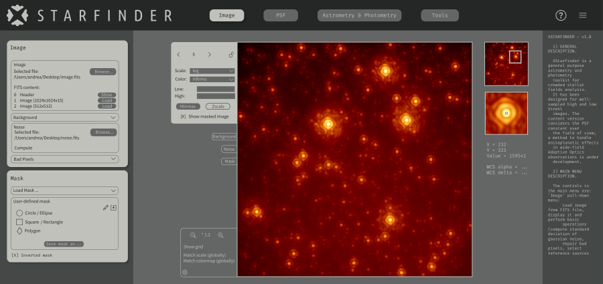
An early version of the brand new Starfinder in Python™ GUI, based on client-server approach.
How to obtain the code
Starfinder is a public domain code. The Starfinder code, the user manual and other important information can be obtained here. The implementation in Python™ developed within this project will be soon released.
Research Units
- INAF – Istituto Nazionale di Astrofisica, CUP: C53D23000810006
Principal Investigator: Dr. Laura Schreiber (INAF-OAS Bologna)
Team members: Dr. Emiliano Diolaiti (INAF-OAS Bologna), Dr. Giuliana Fiorentino (INAF–OAR, Monte Porzio Catone), Dr. Claudia Mignone (INAF–Sede centrale, Rome), Dr. Davide Ricci (INAF–OAPD, Padova), Dr. Maria Tantalo (INAF–OAR, Monte Porzio Catone), Dr. Vittorio Braga (INAF–OAR, Monte Porzio Catone), Antonino Nunnari (PhD Student, University of Rome Tor Vergata) - University of Bologna – Department of Physics and Astronomy “Augusto Righi”, CUP: J53D23001530006
Co-Principal Investigator: Prof. Carmela Lardo (University of Bologna)
Scientific and Technological Impact
By updating and expanding Starfinder, Women Measuring Stars provides the astronomical community with a powerful tool for precise photometry and astrometry in crowded fields observed with AO systems.
The project will also establish a framework for next-generation data analysis in preparation for the Extremely Large Telescope (ELT) era, enabling exploitation of its unique spatial resolution and sensitivity.
Beyond astronomy, the methods developed here can inspire applications in biomedical imaging, machine vision, and pattern recognition.
Educational and Outreach Activities
The project promotes advanced training in adaptive optics data analysis, with targeted activities for graduate and undergraduate students. Workshops and seminars introduce young researchers to high-resolution imaging techniques and software use.
In parallel, a special curriculum has been developed to discuss adaptive optics and astronomical software with secondary school students. The curriculum covers topics relevant to modern astrophysics such as astronomical instrumentation, the underlying optics principles and how observations are turned into data, including practical experiences and hands-on workshops to explore actual astronomical data with free, open-source software. The curriculum was tested in two secondary schools in Italy in the 2024/25 school year.
Social and Historical Inspiration
The project’s title pays tribute to the “Harvard Computers”, the pioneering women who, over a century ago, mapped the sky and transformed astronomy.
In the same spirit, Women Measuring Stars promotes the visibility of women in science and fosters a collaborative, inclusive environment for future generations of researchers.
Scientific Contributions
The WMS team actively disseminates its results through conference presentations and peer-reviewed publications in the field of adaptive optics and astronomical data processing.
Among the first contributions:
- L. Schreiber et al. (2023), How to handle future instrumentation’s large images with a variable and structured PSF using Starfinder2, STARS (Across the Universe) 2023, Napoli.
- L. Schreiber et al. (2024), Women Measuring Stars: a comprehensive strategy for the exploitation of adaptive optics data, SPIE Proceedings, Vol. 13097, DOI: 10.1117/12.3019771
- L. Schreiber et al. (2024), Accurate PSF Analysis; exploiting data from ELT/VLT to Rubin Telescope, passing through James Webb, LXV Congresso nazionale della Società Astronomica Italiana, 2024
- L. Schreiber et al. (2024), Woman measuring stars: a project for the exploitation of adaptive optics data, EAS 2024, European Astronomical Society Annual Meeting 2024.
- Online at https://eas.unige.ch/EAS2024/. Session S13 : Preparing for the first light of the Extremely Large Telescope, Contributed talk Remote, id. 2422
- L. Schreiber and C. Mignone (2025), Women Measuring Stars: un progetto per massimizzare l’impatto dell’ottica adattiva grazie ad innovazione ed educazione, LXVI Congresso nazionale della Società Astronomica Italiana, 2025
- C Mignone et al. (2025), Women Measuring Stars: portare le immagini astronomiche e l’ottica adattiva nella scuola secondaria, Giornale di Astronomia, Vol. 51º · N. 3, Settembre 2025
- M. Tantalo et al. (2025), Globular clusters as diagnostic to verify Adaptive Optics performance, Adaptive Optics for Extremely Large Telescopes 8, AO4ELT8
- L. Schreiber (2026), Why the PSF matters in Adaptive Optics imaging of stella fields (and how to deal with it!), Webinar organised by Osservatorio Astronomico d’Abruzzo (INAF-OAAb)
Further papers and conference presentations will follow as the project evolves, and particularly after the delivery of the new Starfinder version, especially in the context of AO data analysis for upcoming ELT instrumentation.
Educational Activities recordings
- Six-lecture educational programme delivered in hybrid format (on-site and online) at Liceo Scientifico “Rummo”, Benevento, in collaboration with Prof. Maria Ida Moretti and Prof. Arturo Stabile (available only in italian).
News
- https://edu.inaf.it/approfondimenti/cronache-dalla-scuola/quel-pcto-a-velletri-che-misurava-le-stelle/
- Workshop ‘Hands-on Starfinder’ https://indico.ict.inaf.it/event/3513/overview
Contacts
- PI: Dr. Laura Schreiber – laura.schreiber@inaf.it
- Co-PI: Prof. Carmela Lardo – carmela.lardo2@unibo.it