

Project Title
Globular clusters in cosmological simulations and in lensed fields: from their birth to the present epoch
CUP Code
C53D23000990006
Principal Investigator
Francesco Calura, INAF – Osservatorio di Astrofisica e Scienza dello Spazio di Bologna, Via Piero Gobetti, 93/3, 40129 Bologna BO – Italy
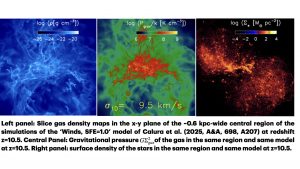
On the theoretical side, a major effort has focused on the formation of dense stellar systems in the early Universe, explored through high-resolution cosmological simulations. In particular, the SIEGE simulation suite has investigated the formation of compact star clusters in the first billion years of cosmic history using sub-parsec resolution and physically motivated stellar feedback models. These simulations demonstrate that extremely dense stellar systems can naturally emerge in early galaxies and may represent the progenitors of present-day globular clusters (Calura et al. 2025; Pascale et al. 2025). Additional work has addressed the fundamental physics regulating star formation, including analyses of gravitational instability in gaseous systems and galactic discs (Nipoti et al. 2024; Bacchini et al. 2024; Nipoti 2026), as well as studies of stellar feedback processes in dense stellar systems (Yaghoobi et al. 2024; Lacchin et al. 2025). Together, these works provide a theoretical framework linking gas collapse, feedback, and the emergence of compact stellar structures in young galaxies.
The observational component of the project has focused on the detection and characterization of extremely compact star-forming structures in strongly lensed high-redshift galaxies, which allow spatial scales of a few parsecs to be probed in the early Universe. Exploiting the magnification provided by massive galaxy clusters, several studies have revealed populations of compact star clusters and star-forming clumps in galaxies during the first billion years of cosmic history. In particular, observations of lensed systems have enabled the identification of extremely compact and metal-poor star-forming regions with intense ionizing radiation (Vanzella et al. 2024), as well as detailed studies of the internal structure of high-redshift galaxies down to parsec scales (Messa et al. 2025). Further analyses of strongly lensed galaxies have provided insights into the nature of early star-forming systems and their ionizing properties (Messa et al. 2025; Vanzella et al. 2026), while spectroscopic and multiwavelength studies have revealed compact star-forming clumps and their physical conditions at high redshift Universe (Zanella et al. 2024). These works demonstrate that gravitational lensing combined with JWST and ALMA observations offer a unique laboratory for studying the small-scale structure of distant galaxies and the formation of stellar clusters at high redshift.
The combined theoretical and observational effort has therefore provided a coherent picture in which compact star clusters and star-forming clumps represent fundamental building blocks of early galaxies, linking the physical processes of gas collapse and feedback with the observable properties of galaxies in the first billion years of cosmic history.
Bacchini, C., Nipoti, C., Iorio, G., Roman-Oliveira, F., Rizzo, F., Mancera Piña, P. E., Marasco, A., Zanella, A., & Lelli, F. 2024, A&A, 687, A115
Calura, F., Pascale, R., Agertz, O., Andersson, E., Lacchin, E., Lupi, A., Meneghetti, M., Nipoti, C., Ragagnin, A., Rosdahl, J., Vanzella, E., Vesperini, E., & Zanella, A. 2025, A&A, 698, A207
Lacchin, E., Donati, M., Calura, F., Nipoti, C., Lupi, A., & Yaghoobi, A. 2025, arXiv e-prints, arXiv:2511.09719
Messa, M., Vanzella, E., Bergamini, P., Castellano, M., Sun, B., Willott, C., Windhorst, R. A., Yan, H., Angora, G., Rosati, P., Adamo, A., Annibali, F., Bolamperti, A., Bradač, M., Bradley, L. D., Calura, F., Claeyssens, A., Comastri, A., Conselice, C. J., D’Silva, J. C. J., Dickinson, M., Frye, B. L., Grillo, C., Grogin, N. A., Gruppioni, C., Koekemoer, A. M., Meneghetti, M., Meštrić, U., Pascale, R., Ravindranath, S., Ricotti, M., Summers, J., & Zanella, A. 2025, A&A, 694, A59
Nipoti, C., Caprioglio, C., & Bacchini, C. 2024, A&A, 689, A61
Nipoti, C. 2026, A&A, 706, A238
Pascale, R., Calura, F., Vesperini, E., Rosdahl, J., Nipoti, C., Giunchi, E., Lacchin, E., Lupi, A., Messa, M., Meneghetti, M., Ragagnin, A., Vanzella, E., & Zanella, A. 2025, A&A, 699, A31
Vanzella, E., Loiacono, F., Messa, M., Castellano, M., Bergamini, P., Zanella, A., Annibali, F., Sun, B., Dickinson, M., Adamo, A., Calura, F., Ricotti, M., Rosati, P., Meneghetti, M., Grillo, C., Bradač, M., Conselice, C. J., Yan, H., Bolamperti, A., Meštrić, U., Gilli, R., Gronke, M., Willott, C., Sani, E., Acebron, A., Comastri, A., Mignoli, M., Gruppioni, C., Mercurio, A., Strait, V., Pascale, R., Annunziatella, M., Frye, B. L., Bradley, L. D., Grogin, N. A., Koekemoer, A. M., Ravindranath, S., D’Silva, J. C. J., Summers, J., Rihtaršič, G., & Windhorst, R. 2024, A&A, 691, A251
Yaghoobi, A., Rosdahl, J., Calura, F., & Ataiee, S. 2024, MNRAS, 528, 5477
Zanella, A., Iani, E., Dessauges-Zavadsky, M., Richard, J., De Breuck, C., Vernet, J., Kohandel, M., Arrigoni Battaia, F., Bolamperti, A., Calura, F., Chen, C.-C., Devereaux, T., Ferrara, A., Mainieri, V., Pallottini, A., Rodighiero, G., Vallini, L., & Vanzella, E. 2024, A&A, 685, A80